
What a San Luis Obispo Resident Lookup Covers
The phrase resident lookup can hide several different goals. A property record confirms an assessment relationship. A deed confirms that a party signed or received an instrument. A court docket confirms a party role and case timeline. A license or business filing confirms a regulated or entity connection. A directory, yearbook, or newspaper gives a historical association. A voter self-lookup confirms only the voter’s own registration. The coverage table keeps those findings in their proper lane.
| Record | What it confirms | Where | Access |
|---|---|---|---|
| Assessor parcel | APN, situs, assessment, and publishable owner or mailing context | County Assessor and GIS | Free web or counter, with limits |
| Recorded instrument | Party role, instrument date, legal description path | Clerk-Recorder | Web index from 1923; older counter |
| Court docket | Case number, party role, chronology, public status | Superior Court | Web, terminal, or clerk |
| Vital record | Birth, death, marriage, or dissolution event by copy category | County or CDPH | Paid and eligibility-controlled |
| Business or license result | Entity role, license status, public address, or discipline | California SOS or DCA | Free state search |
| Directory or yearbook | Historical adult, student, subscriber, or address association | Library, Cal Poly, or archive | Digital or reading room |
The correct conclusion uses the record’s own verb: owns, filed, appeared, held a license, attended, subscribed, or was listed. “Lives at” needs more support than a name appearing in a parcel or business record.
San Luis Obispo Resident Lookup Identity Match
Same-name errors are common in a county with long records, Spanish and compound surnames, initials, accents, and changing address labels. Start with one stable identifier. An APN, document number, case number, entity number, license number, or exact date is stronger than a name alone. Keep former surnames, suffixes, diacritics, hyphens, spaces, and alternate spellings in the search notes.
A two-source match should share two independent facts. A legal description plus a party name is one example. A license number plus city and issue date is another. A probate name plus an obituary date and successor deed can support an heir trail. A business name plus an entity number can separate a registrant from a different person with the same name.
- Write the known name forms, place, date range, and the exact question before opening a portal.
- Find the most stable record key, such as a parcel, case, license, entity, or document number.
- Read the returned role and address exactly as printed. Do not convert a mailing address into a residence.
- Confirm the clue in a separate custodian or collection, using a different date or identifier where possible.
- Record the source, access date, result wording, and any privacy or coverage limit.
- Docket
- A court register of filings, hearings, parties, and case events, not the full file.
- Index
- A finding aid that points to a record; an image or file may carry more detail.
- Certified copy
- A copy issued or certified by the custodian for an allowed purpose.
- Disposition
- The court’s recorded outcome or status for a case or matter.
San Luis Obispo Property Is Not Residency
The County Assessor Property Information Search and LandUseView can be powerful starting points. An APN can tie a name to a parcel, situs, assessed values, use, and a mailing destination. The mailing field tells where tax notices go. It can be a trust, manager, PO box, or other property. A homestead or homeowner exemption may support an owner-occupancy clue, but it is not a list of all household members.
The recorder adds a different layer. The Recorded Documents Search can show a grantor or grantee, deed, lien, reconveyance, easement, map, or legal description. A party may be a lender, trustee, beneficiary, seller, buyer, or representative. Search the actual instrument and its role. When the goal is a person rather than a parcel, use the property result only to establish a time-and-place clue.
The Assessor portal and LandUseView are free starting points, but a protected or absent owner display is not proof that a record is absent. The counter may have a different access path.
San Luis Obispo Resident Lookup Court Fields
The Superior Court of California, County of San Luis Obispo, provides Online Case Information as a finding aid. Search by exact case number when possible. If the number is unknown, use party last name or business name, first name, case type, and a narrow filing-date range. Probate can help identify decedents, personal representatives, heirs, and attorneys. A web result does not guarantee document images.
| Field label | Type | Required route | Format or result note |
|---|---|---|---|
| Case Number | Text | Exact route | Most precise identifier when known |
| Party Last Name or Business Name | Text | Name route | Test spelling and former surnames |
| Party First Name | Text | Optional narrowing | Helps separate common surnames |
| Date of Birth | Date, where permitted | Conditional | May be masked or limited by case type |
| Case Type | Tab or dropdown | Optional | Civil, criminal, family, probate, small claims, traffic, and other availability |
| Filing date range | Dates | Optional | Use a narrow span to separate generations |
A visible docket may include case number, caption, case type, filing date, party roles, judicial officer or department, register-of-actions entries, hearings, and public disposition or status. Minute orders and pleadings may require a clerk request, courthouse terminal, or copy order. Sealed, juvenile, adoption, and confidential portions may not appear.
| Case number | Stable court identifier for the file and later clerk request. |
|---|---|
| Caption and party role | Names the matter and distinguishes petitioner, respondent, plaintiff, defendant, heir, or another role where public. |
| Register of actions | Lists public filings, hearings, minute entries, and case events. |
| Disposition or status | Shows the public outcome or current procedural state when displayed. |
| Document access | Indicates whether a clerk, terminal, copy order, or certification route is needed. |
Federal matters belong in the Central District of California and PACER. PACER uses its own access and charge rules, while sealed federal matters remain unavailable. Use the county court entry point for the local case path. The court’s locations and contact page supplies the clerk route for terminals, copies, and archived files, while the Central District of California site confirms the federal custodian.
Note: A party name shows a court role, not guilt, a current address, or a complete personal history.
San Luis Obispo Vital Records by Copy Type
California’s vital-record system uses authorized and informational copies rather than a simple rule that every old record becomes open. County Clerk-Recorders issue county birth, death, and marriage copies. CDPH maintains statewide birth, death, fetal-death, marriage, and dissolution records. Recent events can also involve the local registrar. Confidential marriages are issued through the county clerk to a party or by court order. Adoption and specified amended records are sealed.
CDPH forms VS 111, VS 112, and VS 113A collect event details, applicant information, relationship or eligibility, intended use, signature, and payment. Mail orders for authorized copies need a sworn statement signed under penalty of perjury and notarized. Informational copies are marked unusable to establish identity. For 2026, state fees are $31 birth, $26 death, $19 marriage, and $18 dissolution, with estimated processing around 4 to 6 weeks.
The CDPH copy explanation should be read before an order. A certificate of no public record can also be the result, and CDPH does not email, scan, or fax certificates. Pre-July-1905 research should turn to county books, missions, parishes, newspapers, cemeteries, and delayed registrations.
San Luis Obispo Resident Lookup Voter Privacy
California My Voter Status is for the voter’s own registration. It requests identifying information and returns the user’s registration status, address details, party preference, vote-by-mail status, and election information. It is not a public name search. County voter-file extracts require an application, identification copy, original initials and signature, detailed purpose, approval, and secure delivery.
The San Luis Obispo application lists countywide, district, city or district, and precinct scope. It names products including MVMJ004, AVMJ010, AVMJ011, MVMR010, and AVMR171. The stated charge is $52 plus $0.50 per 1,000 registered voters, with a $1 DVD option. Data arrives by encrypted WinZip email and may include authorized voter and election fields, never ballot choices. Unauthorized use, commercial use, and harassment are prohibited.
Government Code section 7924.000 and Elections Code sections 2188, 2194, and 18109 protect home street address, phone, email, identifiers, signatures, and other voter data. Safe at Home participants have a separate confidential route. A missing voter result should be treated as a privacy or scope limit, not a prompt to guess.
San Luis Obispo Business and License Records
Business and professional sources can help confirm the right person when the name has a public role. California Secretary of State bizfile searches an entity name or number and can return legal name, status, formation jurisdiction and date, agent, filed addresses, and filing history. County fictitious business name statements can identify a registrant using an assumed name. DCA search fields include board, license type or number, last or business name, first name, city, and county.
DCA results may show license number, status, issue or expiration date, public address, and discipline links. CSLB, Medical Board, Board of Registered Nursing, State Bar, ABC, and other boards have their own record rules. A registered-agent address or license address is a professional or entity clue, not proof of a personal home. Confirm the number before linking a person to a result.
The captured state business search is available from the California bizfile portal.
The screen illustrates why an entity number and legal status are stronger matching clues than a similar personal name.
The state license search is another public record path. Use the DCA license search for the board and field filters.
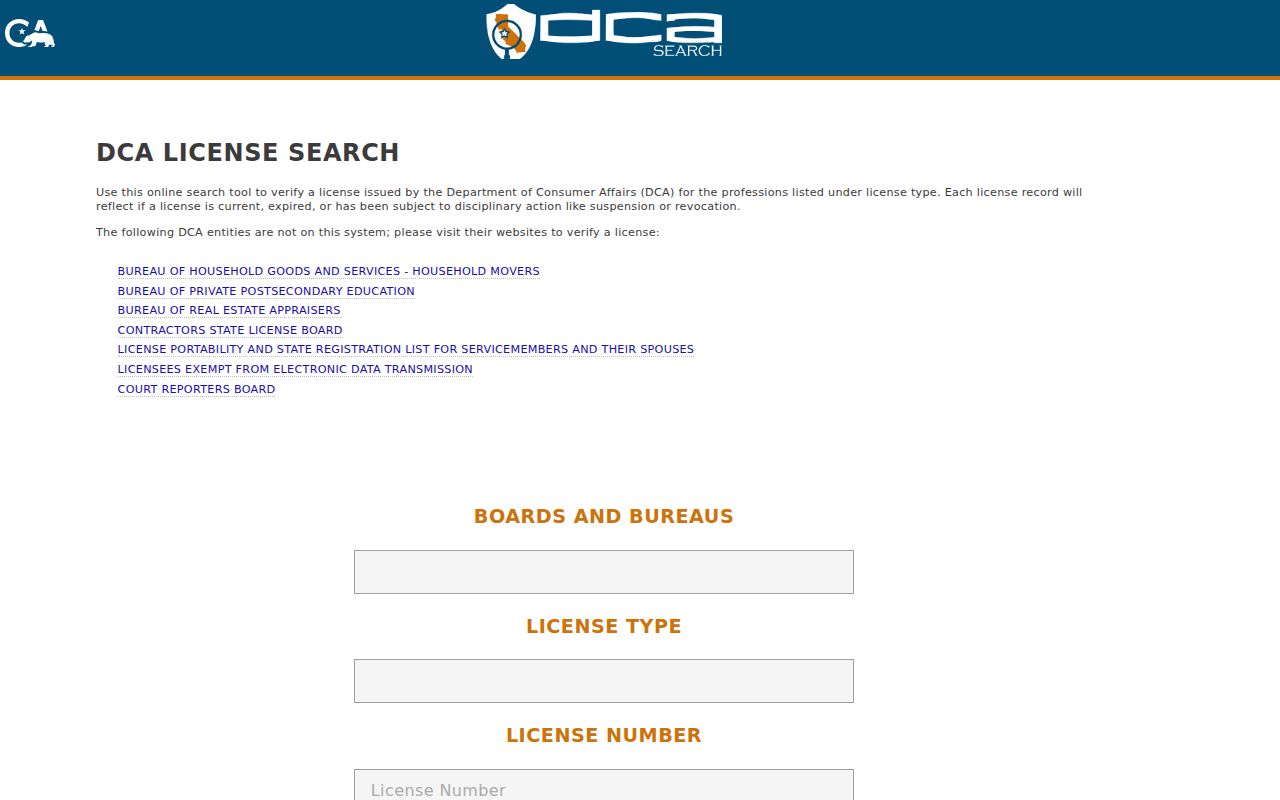
License status, public discipline, and location can confirm an affiliation while leaving residence as a separate question.
San Luis Obispo Resident Lookup Human Trails
Different human uses call for different source chains. An heir search can begin with a probate case, obituary, and recorded successor deed. A former classmate search can use local yearbooks, newspaper microfilm, alumni material, and Cal Poly archives. A birth-parent search must use California’s official confidential adoption, consent, contact, and court procedures rather than a public name index.
For an heir, compare the probate name, decedent date, personal representative, successor instrument, and obituary. For a classmate, compare school, class year, name spelling, and a later source. For a birth-parent matter, contact the relevant CDSS, CDPH, or court program and follow eligibility and consent rules. A public clue can suggest a route but cannot open a sealed file.
California unclaimed property is a separate affiliation search. It can return a reported owner name, address fragment, holder, property type, and property ID. It is not proof of a current place. The captured search is available at the State Controller unclaimed-property portal.
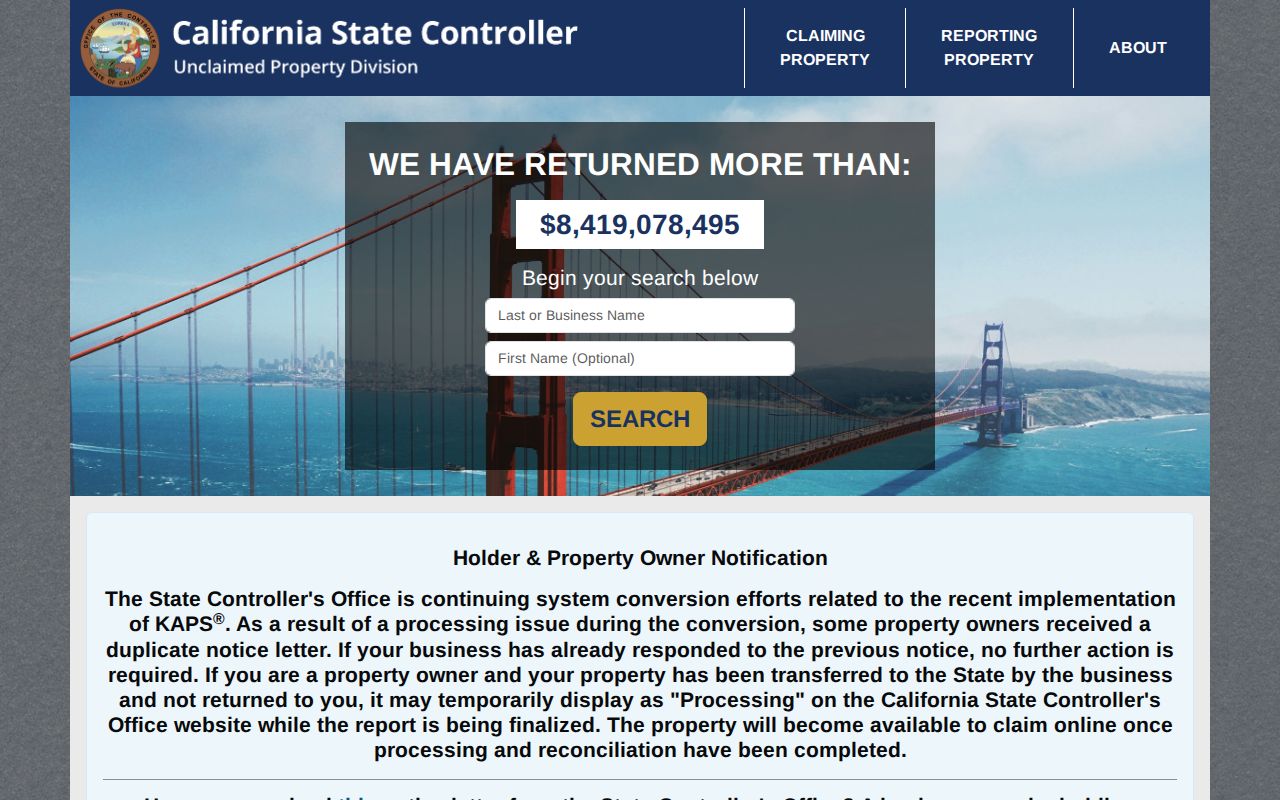
Use the claim path and custodian records to confirm identity; do not treat a reported address fragment as a live resident record.
San Luis Obispo Resident Lookup Registry Boundaries
Some state registries are public within a defined purpose and warning. The California Megan’s Law site offers name and map or address-area modes with statutory exclusions and an anti-harassment warning. CDCR’s incarcerated-person locator uses a CDCR number or first and last name and can show institution or parole information subject to safety exclusions. The county Sheriff custody page is a current-custody source, not a complete history.
Use a registry only for its stated function. Confirm a name, age, identifier, and jurisdiction before assuming a match. Court records, vital records, business filings, and historical sources should be kept separate from a registry result. A public registry does not erase confidentiality rules that apply to another custodian.
The CDCR incarcerated-person locator and San Luis Obispo Sheriff custody lookup are separate custody sources. Their result fields and limits should not be merged with a resident lookup.
The captured state registry image links to the California Megan’s Law search.
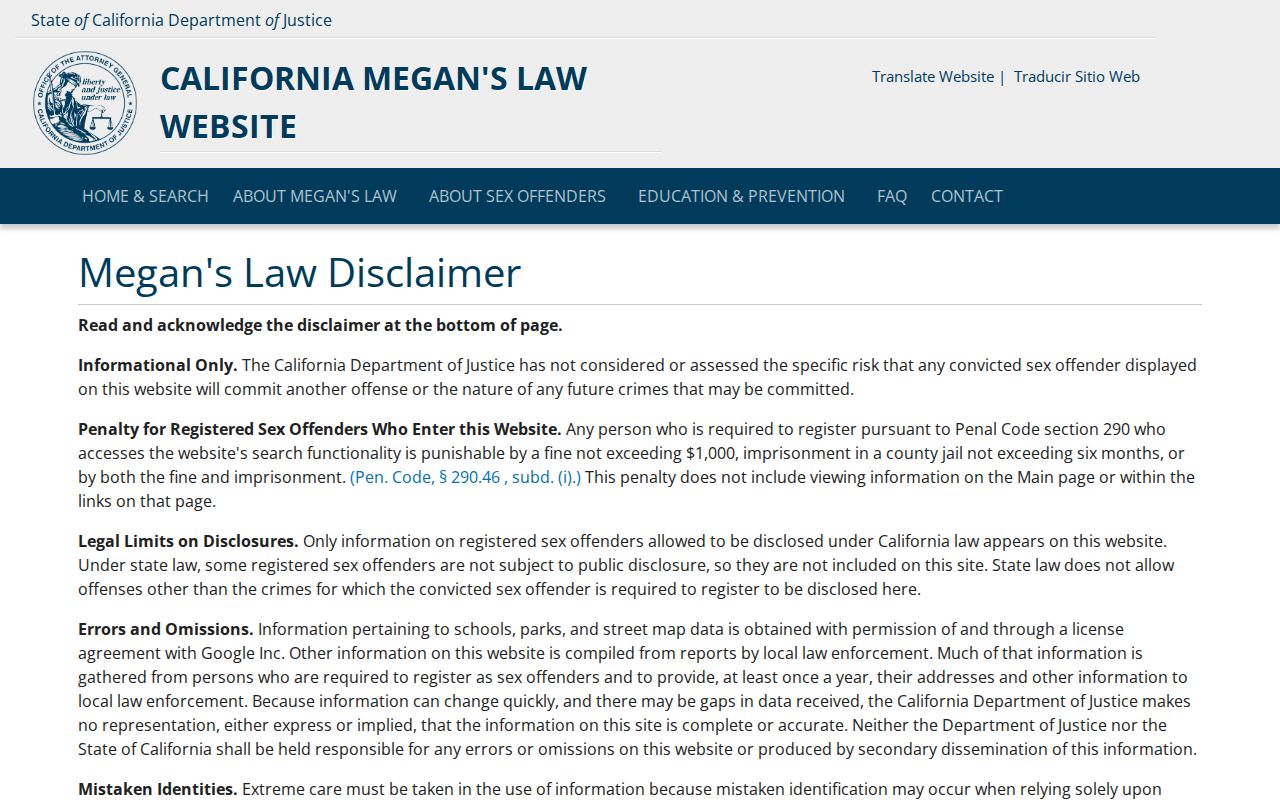
The result surface shows why a registry’s published fields and exclusions must guide the wording of any note about a person.
Legal Limits on a San Luis Obispo Resident Lookup
California law protects more than the visible search box suggests. Safe at Home provides a substitute mailing address and confidential voter registration for eligible participants. DMV data is restricted by the Driver’s Privacy Protection Act. Voter address and identifier fields have controlled release. Recorded documents redact specified sensitive identifiers. Sealed adoption, juvenile, confidential marriage, and protected court material may not appear.
The California Public Records Act can help with an existing, identifiable record when the portal stops. Agencies ordinarily determine within 10 calendar days whether responsive records exist, with a possible 14-day extension for unusual circumstances. The act does not require an office to create a new list or answer a broad research question. Ask for the specific document, permit, agenda packet, or record series and expect direct duplication costs where allowed.
Commercial compilation tools can merge names, use stale feeds, or omit protected records. They cannot correct an official deed, court file, vital record, or voter file. If a result matters, take it to the custodian and preserve the source date.
Lawful personal use. A resident lookup may support genealogy, reconnection, an heir search, a public-role check, or property history. Do not use records to stalk, threaten, intimidate, or harm another person.
Note: The custodian can explain access and correction; a search result cannot rewrite the underlying record.