
San Luis Obispo Residents Directory Starting Points
A resident search works best when the first record is chosen for its evidence, not for its apparent convenience. The County Assessor can connect a parcel to an assessee, APN, situs, and mailing destination. The Clerk-Recorder can show a recorded party and legal description. The Superior Court can show a litigant role and case chronology. A California license, business filing, obituary, yearbook, or directory entry can add a date and a second name form. None of these alone proves that a person lives at a place today.
The strongest San Luis Obispo residents directory trail separates owner, occupant, voter, litigant, licensee, business registrant, and historical directory subject. It also records the search date. An old address can be useful for family history while a current parcel record may reflect a mailing address, trust, manager, or other tax contact. Names with Spanish spelling, compound surnames, initials, accents, and OCR errors deserve several search forms.
- Start with the known name, address, APN, case number, license number, or entity number. A stable number narrows a same-name problem.
- Use the Assessor Property Information Search or LandUseView to identify the parcel and separate situs from mailing information.
- Use the Recorded Documents Search to inspect a deed, lien, map, or reconveyance, then follow the grantor and grantee chain.
- Use My Voter Status only for the voter’s own registration. Treat restricted voter extracts as a regulated request, not a casual list.
- For older people and places, move to the San Luis Obispo Library, Cal Poly archives, the History Center, census schedules, newspapers, and directory shelves.
Note: A name hit becomes useful only after a second record supplies a matching place, date, role, or document identifier.
San Luis Obispo Resident Records Offices
The offices behind a local resident records search have different functions. The San Luis Obispo County Clerk-Recorder records real-property instruments and also handles marriage, fictitious business name, notary, and elections services. The Assessor maintains parcel and assessment context. The elections office controls voter-file access. Court, vital, library, and city records sit with other custodians. A good directory points to the right counter rather than treating every result as a resident roll.
San Luis Obispo County Clerk-Recorder
1055 Monterey Street, Suite D120
San Luis Obispo, CA 93408
805-781-5080
San Luis Obispo County Assessor
1055 Monterey Street, Suite D360
San Luis Obispo, CA 93408
805-781-5643
County Elections Office
Clerk-Recorder service counter
San Luis Obispo, California
805-781-5228
For a city address, also check the relevant city clerk or community-development custodian. San Luis Obispo City Records holds city agendas, minutes, ordinances, resolutions, campaign disclosures, recorded deeds and easements, and advisory-body packets. A permit or public meeting record shows an official connection to a property or event, not a current home.
The county’s Clerk-Recorder service hub is the first office map for recorded documents, marriage, business-name, notary, and elections services.
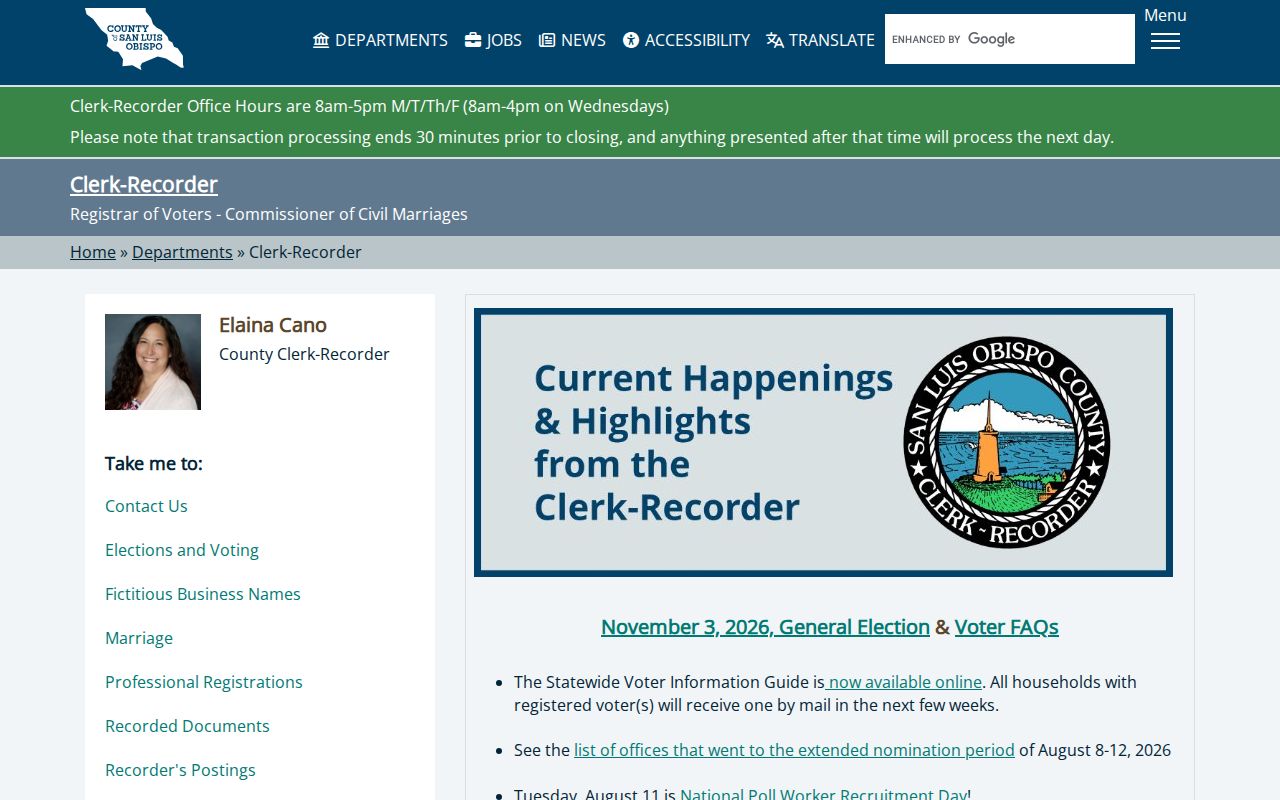
The capture shows why the office name matters: several record families meet at the Clerk-Recorder, but each keeps its own access rule.
The Assessor property search supplies the parcel side of the map.
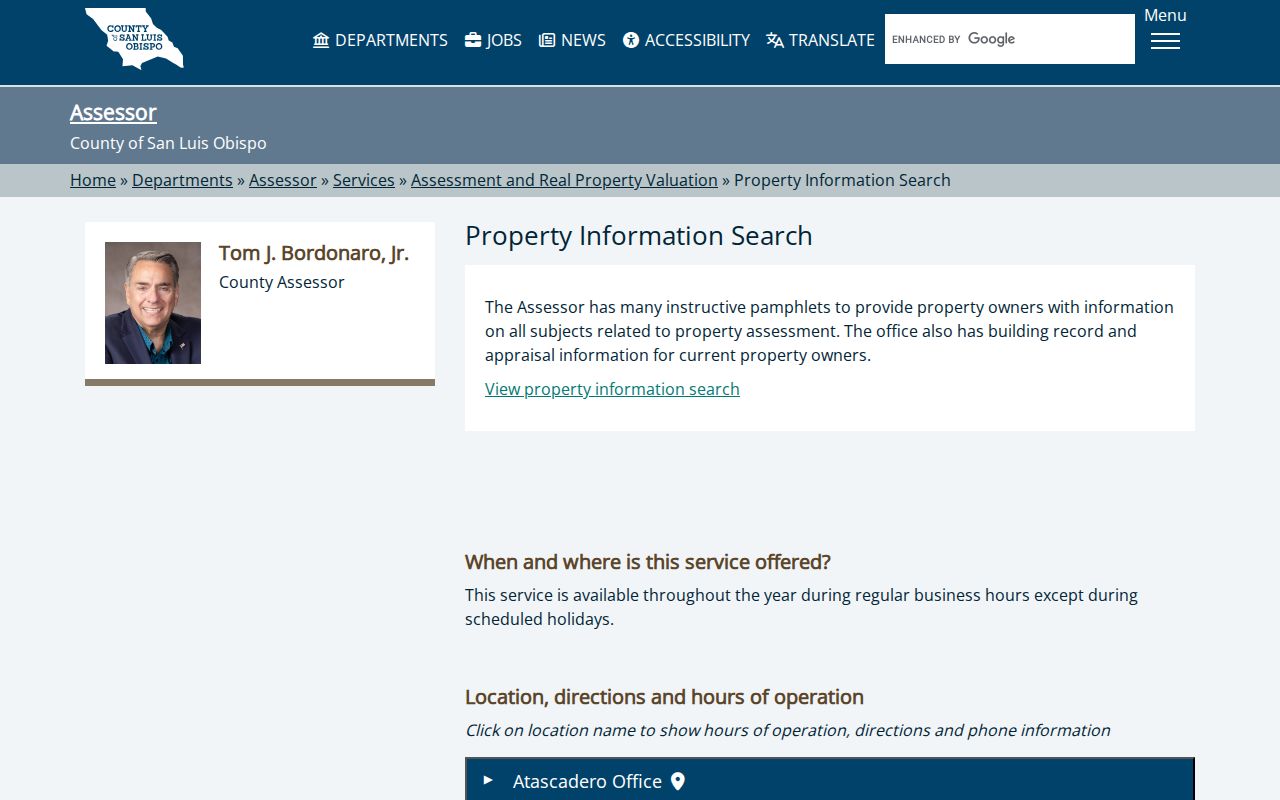
That view starts with a parcel and assessment record, not a complete household list.
San Luis Obispo Resident Parcel Search
The County Assessor is the practical first stop when the known fact is an address. The public property inquiry can connect an APN to a situs, legal or subdivision context, land and improvement values, use information, and a publishable owner or assessee context. Online owner-name searching should not be assumed to be unrestricted. If a protected name or address is absent from the web view, that is a limit on the display, not proof that the assessment record does not exist.
LandUseView adds map context. Search by an address or APN, select a parcel, and inspect nearby polygons. Layer controls can show parcels, land use, jurisdiction, districts, and hazards. Map lines are informative and are not a survey. The assessor’s mailing address is where tax notices go. The situs is where the parcel lies. A mailing address may belong to a trust, manager, post office box, or another property.
| Portal field or control | Type | Use | Limit |
|---|---|---|---|
| Address or APN search | Text or autocomplete | Locate a parcel or site | Accepted formats can vary |
| Parcel attributes | Selected map record | Review APN, situs, use, and assessment context | Publishable owner detail may be limited |
| Layer list | Checkbox tree | Turn on parcels, land use, districts, and hazards | Not a boundary certification |
| Identify or select | Map tool | Click a parcel for attributes and nearby APNs | Does not show every household |
| Measure or print | Optional GIS tools | Make an approximate map view | Use a surveyor for a field boundary |
- Roll
- A custodian’s organized list, such as assessment records, with a defined record purpose.
- Index
- A finding aid that points to an instrument, case, or image rather than replacing it.
- Criss-cross directory
- A historical address or street-order source that can point from place to listed name.
- Parcel
- A mapped assessment unit identified by an APN and related legal context.
Note: The Atascadero Assessor counter at 6565 Capistrano Avenue offers a North County access point, while the main assessor counter remains in San Luis Obispo.
San Luis Obispo Resident Deed Index
The county’s recorded-document history has three dates that should stay together. The Clerk-Recorder states that official records reach 1850. The remote index begins in 1923. Images that can be purchased or downloaded online begin August 8, 2001. That means a web search can end even though the county record series continues. An unfinished result is often an access problem, not a missing deed.
The Recorded Documents Search is a grantor-grantee index. Search a current owner as grantee, inspect the acquisition instrument, note the grantor and legal description, then search the prior grantor as an earlier grantee. Deed, deed of trust, reconveyance, lien, easement, map, and release categories can appear. A deed of trust beneficiary is not automatically the owner.
At 1055 Monterey Street, Suite D120, the counter is open 8 to 5 Monday, Tuesday, Thursday, and Friday, and 8 to 4 Wednesday. Transactions end 30 minutes before closing. Older index books and images may require an office visit, an order, or a focused request. The office’s published title-search guidance is useful when a legal description is more reliable than a changed street number.
For the result itself, record the indexed party and role, recording date, document number, document type, book and page where present, cross-references, and image-order path. The image can add vesting language, signatures, notary information, return address, and legal description, but it remains a record of an instrument, not a live occupancy list.
To see the kind of source behind this date split, the county recorded-documents service is the direct starting point. Its cutoff language is more useful than a generic claim that every deed is online.
The recorded-documents capture below is linked to the same county search service.
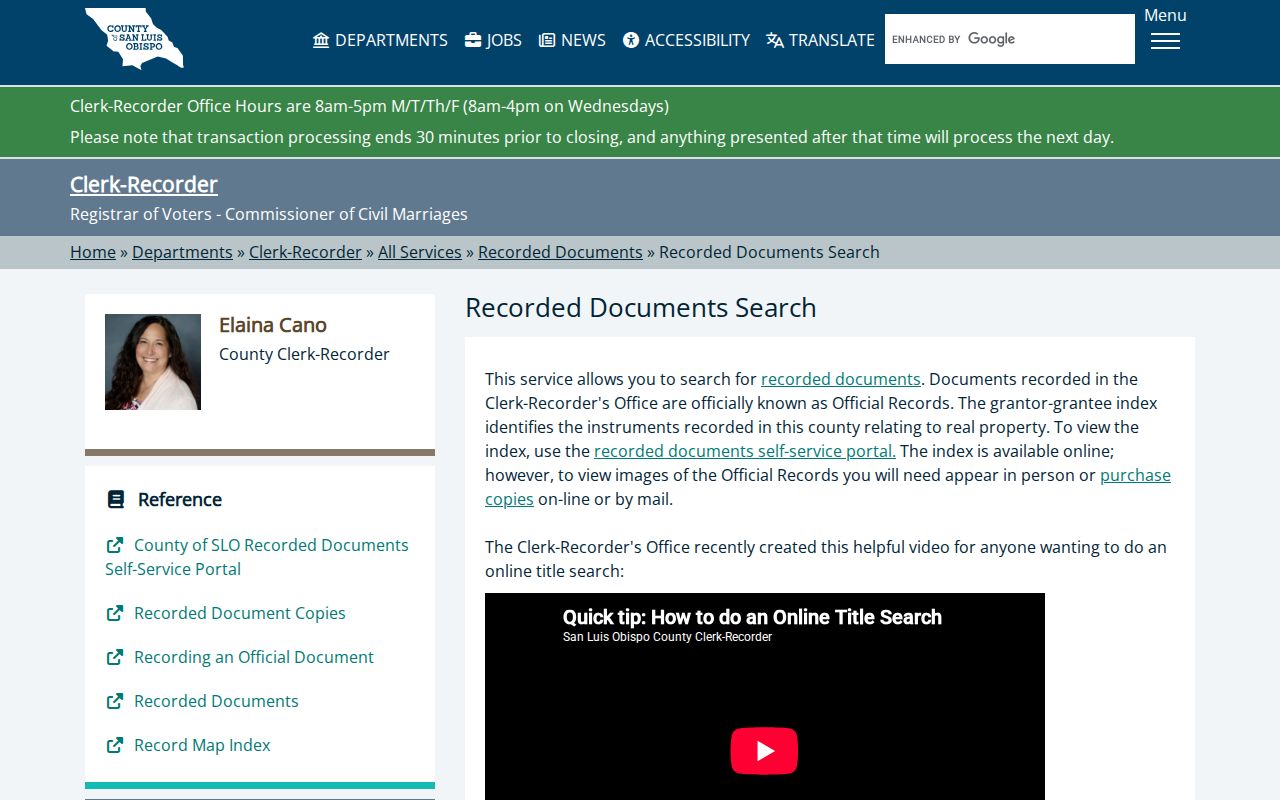
The image belongs beside the date rule because the portal is only one layer of a record series that continues at the counter.
Note: Search the web index through 1923 first, then move to the Clerk-Recorder counter for the 1850 to 1922 gap.
San Luis Obispo Resident Voter Limits
California My Voter Status is a self-lookup. A voter enters the requested name, birth date, and identification fragment to see their own registration status, address details, party preference, vote-by-mail status, and election information. It is not a public name-and-address search for a San Luis Obispo street. Government Code section 7924.000 and Elections Code section 2194 protect home address, phone, email, identifiers, precinct information, prior registration, and signatures subject to controlled purposes.
The county can release a restricted extract only through an application with identification, original signature, a detailed approved purpose, and delivery controls. The form lists countywide, district, city or district, and precinct scope, plus named products such as MVMJ004, AVMJ010, AVMJ011, MVMR010, and AVMR171. The stated fee is $52 plus $0.50 per 1,000 registered voters, with a $1 DVD charge. Approved data is sent by encrypted WinZip email. This is regulated election data, not a resident directory.
Privacy boundary. Use voter information only through the permitted self-lookup or an approved statutory purpose. Do not publish a walking list, infer a protected address, or use a record to stalk, threaten, or harass anyone.
Participants in California Safe at Home should use the program’s confidential registration process rather than the ordinary public-facing registration route. A missing voter result can reflect confidentiality, inactive status, a changed registration, or a display rule. It should not be filled with a guess from a different source.
The self-service interface is available through California My Voter Status.
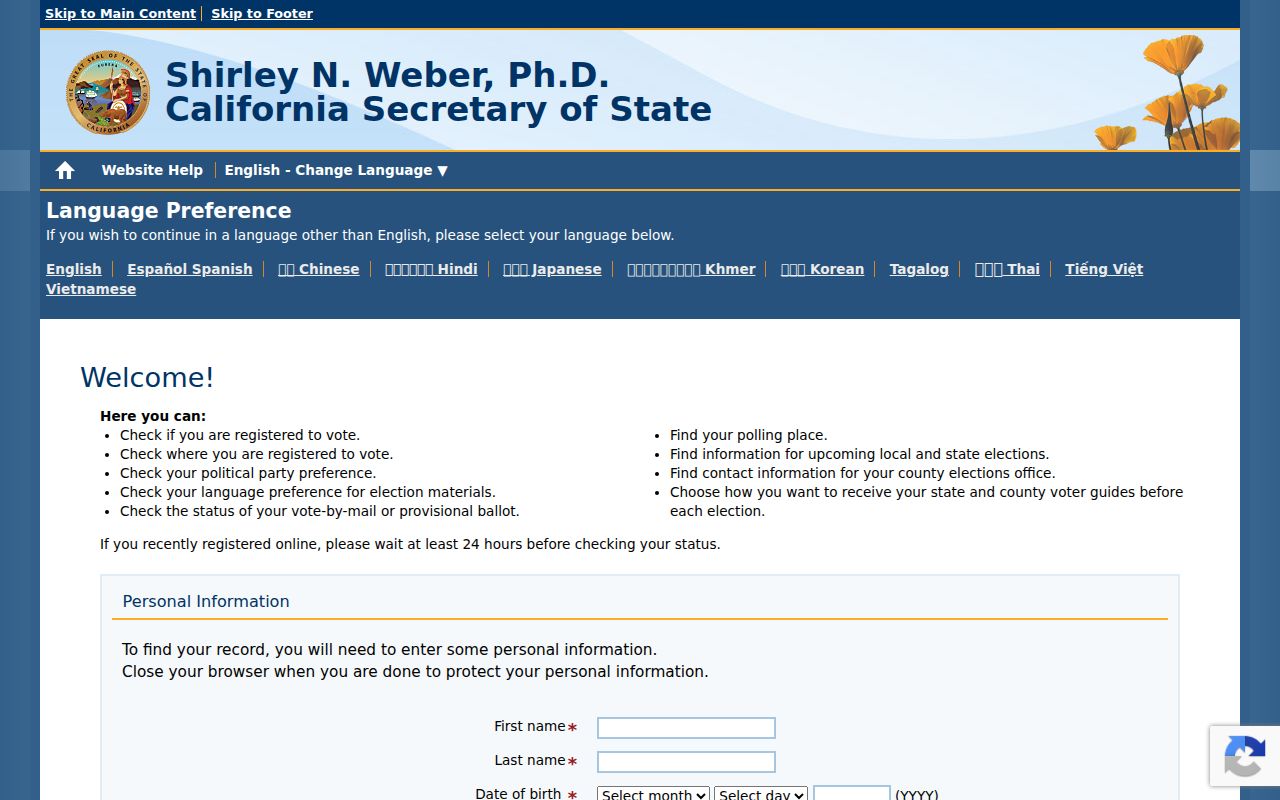
The capture makes the access boundary visible: a voter can verify a personal record, while a public street list is not offered.
Current San Luis Obispo Resident Records
Current sources are useful when their scope is named plainly. The assessor shows parcel and assessment relationships. The recorder shows parties to instruments. A court docket shows a party role in a case. A state license or business filing shows a professional or entity connection. City staff and public meeting records show official roles. A neighborhood contact page may identify an officer or mailbox, but research did not locate a complete public membership directory.
| Source | What it can show | Keeper | Access path |
|---|---|---|---|
| Assessor parcel inquiry | APN, situs, values, publishable owner or mailing context | County Assessor | Web or counter |
| Recorded-document index | Parties, instrument type, date, legal description path | Clerk-Recorder | Free index; copies or images may cost |
| Superior Court case information | Case number, parties, roles, dates, status where public | County Superior Court | Web, terminal, or clerk |
| License or entity search | Professional status or business filing relationship | California DCA or Secretary of State | Free state search |
| City records | Applicants, speakers, officeholders, permits, and public actions | City clerk or department | Archive, permit system, or CPRA route |
| Path | Strength | Limit |
|---|---|---|
| Official county, state, court, library, or archive record | Named custodian, defined fields, date, and correction route | Access limits and incomplete coverage still apply |
| Commercial compilation | May gather several clues in one interface | Feeds, costs, freshness, and same-name matching can be unclear |
Each row answers a different question. A business filing can identify a registered agent and filing address. A DCA result can show a license number, status, public address, and discipline link. Neither turns a business address into a residence. A city permit can identify an applicant or contractor while plans may require permission to copy. The record’s role is the fact.
San Luis Obispo Resident Vital Records
Birth, death, marriage, and dissolution records are not one open roll. California separates authorized certified copies from informational copies, and confidential marriages have a narrower route. The county Clerk-Recorder handles county copies and public or confidential marriage services. The California Department of Public Health maintains statewide records and forms. Recent births and deaths also involve the local registrar. A copy can confirm a life event without becoming a public proof of a current address.
For 2026, the CDPH schedule lists $31 for birth, $26 for death, $19 for marriage, and $18 for dissolution certificates. The state estimates roughly 4 to 6 weeks for processing. Mail applications use VS 111 for birth, VS 112 for death, and VS 113A for marriage. An authorized copy requires the statutory eligibility category plus a sworn statement signed under penalty of perjury and notarized for a mail order. Informational copies carry a legend that they cannot establish identity.
- Birth
- Statewide registration begins July 1905. Authorized and informational paths differ; adoption material can be sealed.
- Death
- County and CDPH routes exist. Cause and medical detail follow separate access rules.
- Public marriage
- Use the county that issued the license or the CDPH route, with copy category limits.
- Confidential marriage
- Available through the issuing county clerk to a party or by court order.
- Dissolution
- The Superior Court decree and a CDPH certificate are different records.
Historical work before July 1905 should move to county registers, mission or parish archives, cemetery records, delayed registrations, newspapers, and family sources. The CDPH Vital Records hub explains the state and local division of responsibility. It is safer to name the copy category than to promise that an old certificate is automatically open.
See the authorized and informational copy explanation before placing an order. It separates a genealogy lead from a document that can establish identity.
The statewide vital-record entry point appears in the capture below.
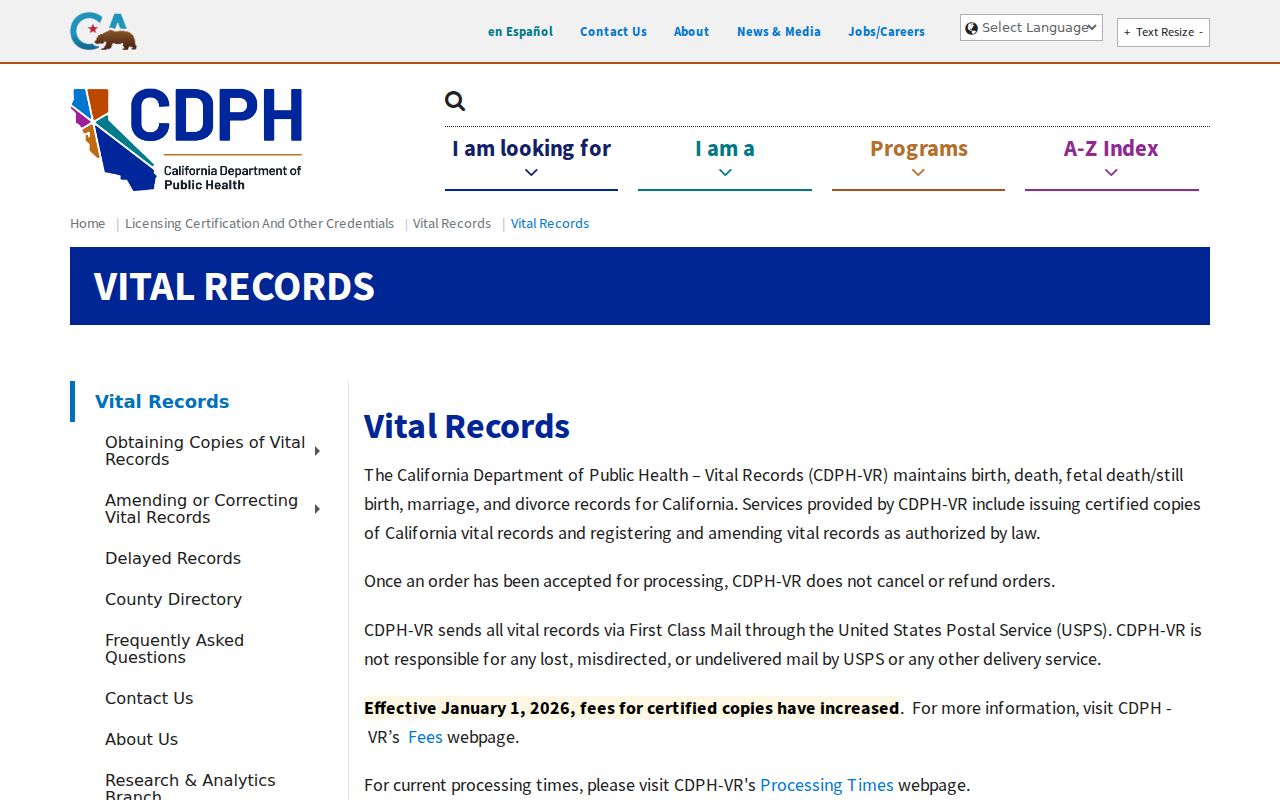
The image pairs with the copy table by showing the state custodian route without flattening authorized, informational, and confidential records into one group.
San Luis Obispo Resident Court Dockets
The Superior Court Online Case Information portal can help locate civil, criminal, family, probate, small claims, traffic, and other county case information where the court makes it available. Search by exact case number when possible. Otherwise test party last name, business name, first name, filing-year range, and case type. A docket is a register of case events. It is not the full clerk file and it is not a criminal-history certification.
A public result may show case number, caption, party roles, filing date, judicial officer or department, register-of-actions entries, hearing dates, and public disposition or status. Minute orders and pleadings may require a clerk request, a courthouse terminal, or a copy order. Sealed, juvenile, adoption, confidential family, and protected portions of cases may not appear. A pleading address is supplied for a proceeding and can be stale.
Probate can be valuable for an heir search because it may identify a decedent, personal representative, heir, attorney, and successor path. Match the name to a date and property record before treating it as the right person. Federal matters belong in the Central District of California and PACER, where access and document charges differ from the county portal.
Note: A docket points toward a file; the clerk’s file, terminal, or certified copy controls when the exact document matters.
Historical San Luis Obispo Resident Directories
The free 1901 San Luis Obispo City and County Directory is the clearest local historical anchor. It covers the city and county, includes resident and business entries, describes the region, and carries advertisements. Search community headings and rural entries as well as the city alphabetic section. An entry may include surname, given name or initials, trade, residence or business location, spouse or widow notation, boarding or residence abbreviations, and cross-references. The printed abbreviation key controls what a mark means.
The San Luis Obispo Library Local History Collection holds county-history books, high-school yearbooks, documents, and local newspapers on microfilm. Ask the catalog or reference staff about Polk volumes, telephone books, reverse directories, and vertical files because the official page does not publish a complete shelf-by-shelf run. Cal Poly Special Collections adds university records, photographs, manuscripts, student publications, and regional material. The History Center’s research room in the Carnegie Library works with collections that are often stored off-site, so advance detail helps.
Telephone pages held by the Library of Congress include a verified August 1961 to August 1963 run. These can place a subscriber or business at an address for a publication period, not every person in a household. Pair directory pages with the nearest census, deed, newspaper, yearbook, or obituary. For the full collections workflow, use the San Luis Obispo city directory book page.
The 1901 volume matters because it sits between the 1900 census and later statewide civil registration. It can reveal a trade, proprietor, boarding notation, or rural community that a deed does not. A missing name can reflect a missed canvass, changed spelling, relocation, or a page that OCR cannot read. Browse nearby pages when a text search fails.
San Luis Obispo Directory Library Shelf
The San Luis Obispo Library is a practical fallback when a web search ends. Its Local History Collection includes county books, local high-school yearbooks, documents, and newspapers on microfilm. Genealogy Library volunteers supported by the San Luis Obispo County Genealogical Society can help orient a search by name, date, community, or record type. Current volunteer hours and appointments should be confirmed through the library or society.
The History Center, chartered as the county historical society in 1953, keeps photographs, documents, vertical files, and artifacts. Most holdings are off-site, so a request with a person, community, time span, and desired source gives staff a better chance of finding the right box. Cal Poly’s archives can be the better match for students, faculty, university organizations, campus newspapers, and regional manuscripts.
Church and mission registers may bridge the period before California’s statewide birth registration began in July 1905. Mission San Luis Obispo de Tolosa and parish archives control their own sacramental access rules. Newspapers can supply an obituary, marriage report, social note, business notice, or address clue, but a published item should be checked against a primary record when the fact matters.
The History Center research page is the source for the local archival fallback shown here.
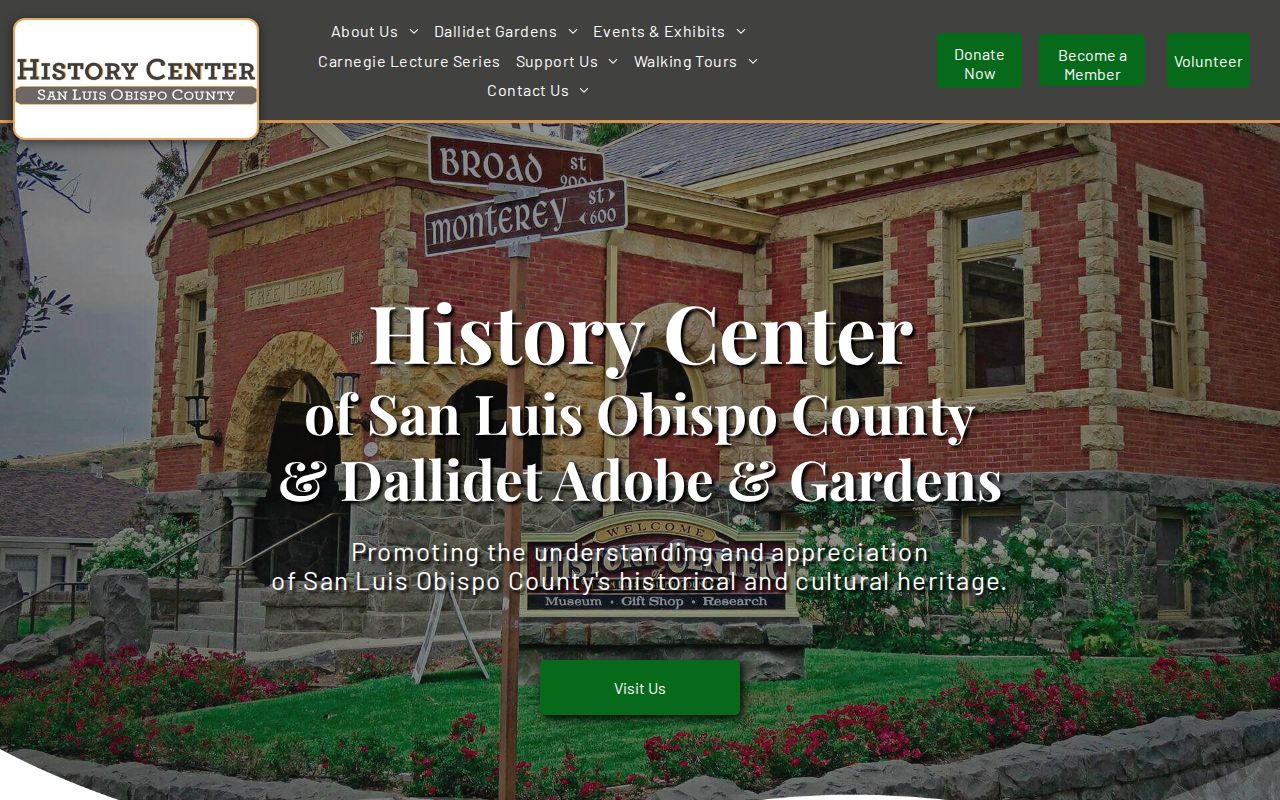
The capture points to a research room and collection network, not a searchable current resident roll.
San Luis Obispo Resident Privacy Stops
A public record can still have a protected field. California’s Safe at Home program gives eligible participants a substitute mailing address, mail forwarding, service-of-process agent, and confidential voter registration. Voter addresses and identifiers have their own access rules. DMV data is restricted by the Driver’s Privacy Protection Act. Recorded documents redact Social Security numbers and specified sensitive identifiers. These limits explain why a careful San Luis Obispo residents directory may show an owner but not a household.
The California Consumer Privacy Act and California Privacy Rights Act give qualifying consumers rights to know, delete, correct, limit certain sensitive-data uses, and opt out of sale or sharing, subject to exemptions and verification. California’s DELETE Act creates a state deletion mechanism for data-broker activity. An opt-out can change a commercial compilation. It cannot erase an official deed, court file, or legally retained public record.
Use the Safe at Home guidance for eligibility and substitute-address rules. Use the California Attorney General privacy guidance for state rights. Do not attempt to work around a protected address, publish a walking list, or turn a partial result into a claim about a person’s home.
Personal research only. Records can support genealogy, reconnection, property curiosity, and civic research. They are not permission to stalk, threaten, intimidate, or harm another person.
San Luis Obispo Resident Business Trails
When a person is known through a business or profession, use the record built for that relationship. California Secretary of State bizfile searches an entity name or number and can return legal name, status, formation jurisdiction and date, agent, filed addresses, and filing history. County fictitious business name statements can connect a registrant to an assumed name. The Department of Consumer Affairs search accepts board, license type or number, business or personal name, city, and county filters.
License results may show status, issue or expiration date, public address, and discipline links. Contractors, health professionals, attorneys, alcohol licensees, and other regulated occupations have separate custodians and fields. A registered-agent address, license address, permit address, or business premises is an affiliation clue. It is not proof of a residence. The same person should be matched by entity number, license number, city, date, or a second record.
These trails are especially useful in a county shaped by agriculture, vineyards and wineries, tourism, construction, health care, education, government, and Cal Poly activity. For a person search, a business filing can add a stable name form while an old directory or court file supplies a date. For a property search, a permit can explain why a name appears at an address without turning the applicant into an occupant.
San Luis Obispo Resident ZIP Mismatches
San Luis Obispo County has seven incorporated cities, coastal communities, inland towns, university land, and broad rural areas. Postal place names cross those government lines. Arroyo Grande, Atascadero, and Paso Robles ZIPs can reach unincorporated land. Shell Beach may appear with Pismo Beach. Baywood Park and Los Osos can be grouped or separated in a catalog. Building and code records follow the responsible city or county, not the postal city printed on an envelope.
The assessor and GIS can test the jurisdiction. USPS can verify the delivery address and ZIP. A recorded legal description or APN can settle a parcel question. A Census ZCTA can support a population statistic only when the geography and vintage are named; it is an approximation of delivery areas, not a USPS boundary. A San Luis Obispo mailing address alone should not decide which permit custodian holds a file.
For rural research, a ranch name, subdivision, road variant, or legal description may work better than a modern street number. Try both the community name and the governing jurisdiction in a directory or newspaper catalog. “SLO” is common shorthand, but official indexes may require “San Luis Obispo.” These small choices can determine whether the San Luis Obispo residents directory trail finds a real record or a false absence.
Note: Verify the exact address with USPS, then confirm the governing city or county in LandUseView before requesting a permit or code record.